Wow, I've been incredibly lazy about posting since my return to Mexico. Here's a photo I snapped of the odd phenomena of street stands that specialize in illegally pirated religious music and videos.
Wednesday, February 2, 2011
What would Jesus pirate?
Wow, I've been incredibly lazy about posting since my return to Mexico. Here's a photo I snapped of the odd phenomena of street stands that specialize in illegally pirated religious music and videos.
Friday, December 24, 2010
More rambling about Mexican Immigration
Pictured above, our xmas nativity.
I made it through Veracruz, passed a few pleasant days in Oaxaca, and headed back to Guadalajara.
Sadly, going back to Guadalajara meant going back to the immigration office. Of course my paperwork had been rejected once again (for mysterious reasons), and now I would have to pay a huge fee for a special letter allowing me to leave the country for Christmas. This time I got an "audience" with some big boss to protest the situation. Typical of Mexico, behind the supposed web of intricate bureaucracy and complex rules there is a swaggering patrón who decides everything according to his capricious moods. The "audencia" happens right in the packed waiting room of the lobby. El Patrón calls out names one by one, and you have to push forward and make your case before he loses interest or someone else grabs his attention. Unfortunately, I hesitated a bit after he barked out "¡Dígame!" (tell me!). That, combined with my accent, was too much. He cut me off before I got a whole sentence out and told me to write my NUT number on a scrap of paper so he could research my case file. Then I had to wait another two hours before talking to him again. There are worse fates though. Another guy (who was a native Spanish speaker) failed to respond after his name was called 3 times. When he finally did answer, El Patrón contemptuously crumpled up his slip of paper in front of him and skipped to the next person.
This was the last day before the offices closed for Christmas. If my papers weren't in order, I wouldn't be able to get back into the country. In the end, Jenny who works at the American School, had to talk to someone to talk to someone so that an expert with inside connections could come to my rescue. Having spent from 8:30 am to 4:30 PM, I was the very last person there, but I finally got my damn work visa extended for another year. Since I'm not staying that long, this means I should never, never have to go back there again...(knock on wood).
Now I am back in the land of War on Christmas for a few weeks to relax, drink non-poisonous water straight out of the tap, be cold, and other such yuletide traditions.
Tuesday, December 14, 2010
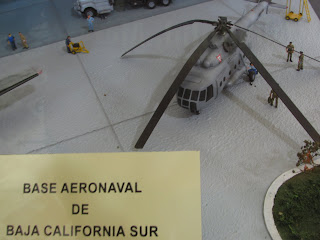
Helicopter blades correctly installed and vehicle is ready for takeoff.
I love museums in general, but they can´t all be winners. When I was a kid I was very attached to a "Pirates & Buccaneers" coloring book, which I think is what led me to think going to the Veracruz Naval Museum would be a good idea. After all, a venerable museum in this historic port should be filled with Spanish cannons, old maps, cutlasses, blunderbusses, pirate flags, and so on. Unfortunately, this tourist attraction would be more aptly named "The Veracruz Museum of Falling Apart Dioramas and Blurry Photocopies." The building is a former naval academy and it is staffed by uniformed women of the Mexican Navy. They operate it as they would any other military bureaucracy, with a curious attention to the minutia of regulations. The attendant watched like a hawk as I filled in each blank of the guest registry, and shook her head "no" when I left one space empty. I didn't understand what the question was asking, so I just wrote my name again. Next, she marched me to the big board to explain the layout of the museum, which rooms I was to visit in what order, and a brief recap of their contents. In some Mexican museums the guards get freaked out if you don´t go through the exhibition halls in the prescribed order. This was definately one of those museums. Naval officers patrolled the halls to shepherd visitors to the rooms they were supposed to go to next. Often they would make curious announcements such as "When this building was a naval academy, the chemistry classroom was here."
The actual contents of the museum were quite dismal. Probably 1 in 30 displays contained an original artifact. Many of them didn't actually say "reproduction", but they clearly were. For example the statue of the Aztec flower god that A) Is actually in The National Museum of Anthropology in Mexico City B) HAS NOTHING TO DO WHATSOEVER WITH NAVAL HISTORY. Other highlights included photocopies of portraits of Cortes, photocopies of letters to and from the King of Spain, and photocopies of maps. There were, humorously, pirated pirate flags though--the museum staff had clearly made them with black cloth and house paint.
The oddest gallery in the museum may have been the "modern navy" section. The hall used photographs of training exercises and dioramas to try to construct a kind of GI Joe fantasy world where the Mexican Navy was storming beachheads, launching succesful amphibious assaults, and exploring underwater sea caves with spear guns.
The single most interesting thing in the museum was a stained glass window on the staircase that some cadets were covering over with plywood. Probably they wanted to put a giant color photocopy on top of it.
As dull and miserable as the museum was, I felt some anxiety about leaving because I knew that the attendant would force me to write a comment in the guestbook. Sure enough, when I tried to walk past and ask for my bag back, she looked down at the registry, back up at me, and issued a crisp "Sus comentarios, POR FAVOR." I considered "bien lleno de fotocopias" or "este no es un museo," but I couldn´t with her eyes bearing down on me. I knew I had to write something postive and my contempt would have to lie hidden in the brevity of my praise, so I settled on "bueno." It was a little pathetic, this is what Mexicans say when they answer the phone. She was not satisfied; previous guests had composed whole paragraphs of praiseful commentary. Finally I added "gracias," which was enough to coax her into handing my bag back, if grudgingly.
Yet more things from the Xalapa Museum of Anthropology continued part 2: toys
Monday, December 13, 2010
Yet more things from the Xalapa Museum of Anthropology--decapitated ball player
Sunday, December 12, 2010
Zempoala
Continuing my wander through Veracruz, I stopped at these Totonaco ruins. They´re especially notable for being the first city the Spanish encountered in the Americas and a stepping stone in the conquest of Mexico. When Spanish scouts reported a city built of pure silver in the distance, Cortes and his men set out immediately, but it turned out only to be the polished white stucco gleaming in the sun. Still, Zempoala was a pretty advanced city with temples, defensive walls, systems of drainage and irrigation. King Chicomacotl (who was not exactly chico, he was too heavy to walk) recieved Cortes with lavish gifts, and the two formed an alliance against the Aztecs. One informational plaque noted that Chicomacotl personally offered Cortes 7 ladies, including his own neice. But I´m sure that being such a devout Christian gentleman, Cortes must have responded by lecturing him about sex outside of marriage, ha ha.
In the photo above, I was standing in the middle of a ceremonial gladiator ring. The crenallations atop the low stone wall would have been hidden under elaborate leaf-shaped stucco ornamentation. Warriors captured in the flower wars were brought here to fight to the death. The "home team" so to speak, got to use macuahuitles (wooden swords mounted with razor sharp obsidian blades). The captured warrior weilded a similar instrument, only instead of razor sharp blades, his weopan was studded with feathers. If he somehow managed to defeat his enemy anyway, he had to immediately fight a second warrior. If he won again, he was set free and given all kinds of gifts. This almost never happened though.
In the background is the most important building of the city, the Templo Mayor. It was the site of various shennanigans by Cortes. Here he ordered the idols smashed and a Christian mass to be given to the puzzled Totonacos. Later it was the location of a battle between Cortes and Panfilo de Narvaez, who the governor of Cuba had sent to stop him pillaging and raping strange lands against orders. When Panfilo´s eye was put out, he was obliged to surrender, and suddenly Cortes had even more men under his control.
Despite its historical importance, this was a very laid back place to visit, practically deserted. There were only four other visitors, two of which were teenagers from the town making out behind the temple of the wind god. Only a chain link fence divides the most important buildings from the town. There is another pyramid in a vacant lot beside some store, and even more out in the sugar cane fields. I asked one of the guards about them, and he said that if you give them notice they will take you on a tour, but going alone "no es recomendable." Apparantely the farmers get freaked out by unaccompanied tourists, and its best not to upset a man with a machete in hand.
Subscribe to:
Posts (Atom)


