Wednesday, November 10, 2010

Movie review: Los herederos


The Museo de Arte de Zapopan has a weekly series of free movies, so Jenny and I have been going to practice our Spanish and take in a bit of high culture (not easy to do since Guadalajara is basically an overgrown village with some factories and urban sprawl tossed in). Last night we saw Los herederos (The Heirs), a film about child laborers in Mexico. It's a Frederick Wiseman-like documentary, with no narration at all. For the most part the camera just follows children as they make bricks, carry water, pick green beans, weave, make tortillas, and so on.

As the title ironically implies, they are the victims of generational poverty. The children depicted were all working in the countryside, but in different situations and areas of Mexico. On one hand, it was engrossing to watch kids who could do pretty intense work at an early age. How many 7 years olds do you know that can hitch up a mule? Or use jungle vines to tie fast a heavy bundle of firewood? Or use a machete? Many of the rich 18-20 year olds I teach probably couldn't even make a cup of coffee. In this sense there is something admirable about everyone from the 4 year old son to the 90 year old grandmother working together without complaint. Watching them follow a path through a cornfield to fetch water and plant seeds and feed the turkeys (a bird first domesticated by the ancient mesoamericans), you realize all of their ancestors did the same thing stretching back literally thousands of years.

The thing I enjoy about this style of documentary with no narration is that it invites you to daydream as you watch. I started to wonder if in all societies it has been normal for children to work just like everyone else at some point in history, and to imagine myself in the same situation.

Well, there is child labor and there is child labor. Other children in the film worked with their families picking produce on giant industrial farms. Both Jenny and I came to the same conclusion, that it seemed little better than slavery. The families were herded in and out of semi-trailers to do the same repetitive thing all day in the hot sun. It's outside, but its basically a factory from the 1800's. The thing that seems so horrible about children doing this kind of work is that they're not learning anything. They're being used as farm animals at a time when they should be playing, learning, growing, etc. Maybe the little girl helping her mother weave should be in school instead, but at least she's like an apprentice. Picking cucumbers all day on someone else's land there is nothing to learn, not much to be proud of, no way of improving yourself. And I'm sure they're paid so little that even with the whole family working they can't save a penny. Who owns this farm? How did they acquire it? The film doesn't tell us, but the history of Mexico is filled with examples of people forced to work for next to nothing on land they used to own before some culero took it away from them. I think if folks really wanted to stop illegal immigration, they would have to stop paying attention to America's toughest sheriff and start looking for solutions on this farm.

Here is a link to the trailer. There isn't much dialogue, so the language isn't important.

Thursday, November 4, 2010

language struggles

Well, my Spanish may not be improving that much right now, but my English is certainly getting worse. I hear some incorrectly used words repeated so often by language students that they are beginning to sound normal to me. Consider:

"I'm going to put you a quiz on Friday."

"You have a lot of absences, so you'd better start working on your assistance for this class."

"I arrived to Guadalajara 3 years ago."


Wednesday, November 3, 2010

Santisima Muerte

Last Sunday I picked up these two framed Santa Muerte (Saint Death) posters at a flea market. Oddly enough, these are religious images, created by people who would consider themselves Christian. Here is my rough translation of the text on the right hand (battle axe wielding) one:
Prayer to Saint Death
In the name of the Father, the Son, and the Holy Ghost, immaculate being of light, I implore that you grant me the favors which I ask of you, until the last day, hour and moment that your divine majesty orders that I be brought before your presence. Beloved Death of my heart, do not remove me from your protection.

The cult of Santa Muerte is pretty fascinating, and I wish I knew more about it. It is definitely a lower class thing though, while most of the Mexicans I know are university educated professionals. I have read a few US based media reports linking the cult to drug traffickers, but I wonder if that isn't inflated to give an easy explanation for something that appears "evil" to outsiders (including the official Mexican Catholic Church). According to Devoción a la Santa Muerte Magazine, issue #6 (probably the best thing I've ever bought for under $1), "La Santisima Muerte NO castiga, ni se lleva a uno de nuestros queridos, sólo viene a ayudarle y guiarle espiritualmente." (Most Holy Death does not punish, nor does she carry away our loved ones, she only comes to help them and to guide them spiritually). The same magazine features testimony from a variety of people who are clearly not devil worshippers or narcos. A hospital worker sees visions of Santa Muerte at her work place, and patients are miraculously cured. A family writes to the magazine to thank her for saving them from death in a car crash. A housewife reports that after praying to Santa Muerte, her teenage son no longer hangs around with juvenile delinquents.

The magazine also provides some helpful tips on how to thank Santa Muerte with offerings for the miracles she bestows. Wine should be left at the altar in a glass goblet, and the bottle should be left uncorked so she can enjoy the aroma. Chocolates should be unwrapped, and can placed in any kind of dish. Cigars and cigarettes must always be offered lit. Flowers should be as beautiful and fresh as possible. Finally, do not make false promises to Santa Muerte or it is unlikely that she will help you again in the future.

Santa Muerte is often linked to the goddess Mictlancíhuatl, queen of one of four Aztec hereafters. She was not the only female Aztec deity to be depicted with a skull face though. The earth goddesses Coatlicue and Cihuacóatl both had a nurturing protective/ raging bitch duality, and could take terrifying skeletal forms. Women who died in childbirth also became goddess like skeletal beings. As childbirth was considered a form of combat, they were accorded the highest status, to accompany the sun in his daily battle to cross the sky. Who knows what elements of European folklore contribute to Santa Muerte. While odd Mexican customs are often attributed to its pre-hispanic past, the medieval outlook of the colonizers is certainly a factor too. Antiquated Spanish notions have sometimes lingered in Mexico long after having disappeared from their country of origin. The appearance of Santa Muerte has more Western iconography than Mesoamerican (scales, globes, scythes and so on).

Here is how the magazine's editor responds to those who say the cult of Santa Muerte is devil worship. "Now I do not know why they fear her and flee from her, if late or early we all will pass through that final material stage and begin the spiritual one..."

Sunday, October 31, 2010

Absentee voting


I voted an absentee ballot last week, though I'm not sure it will ever arrive in the USA. I did take it to the consulate so it would get there on time. I've always heard consulates and embassies are like foreign soil, a little outpost where the other country exists in miniature. I was kind of imagining that I would step inside and there would be a guy in a Hawaiian shirt barbecuing steaks. Or at least a seasoned bureaucrat with a firm handshake and a no nonsense attitude who always displays a framed photograph of the current president next to the miniature flag on his desk.

Instead, I found myself waiting in line on the sidewalk to talk to some low level Mexican security guard through a staticky microphone on the other side of a window. No old glory rippling proudly in the breeze, no English spoken, no one with any particular knowledge of absentee voting procedures. I knew I was in trouble when the Mexican lady in front of me started griping (in Spanish of course) that she couldn't understand the guy behind the window because of all the static.

I had left the envelope unsealed because I figured if I had done something wrong, an embassy official could help me. Realizing that there would be no such help, I went to seal the envelope only to realize that there was no glue on the flap. It makes sense, really. In a country without a functioning mail system, why would you need to seal an envelope? The guy behind the window had nothing to seal the envelope with. He suggested that if I came back next week there would be an election official who could help me. Instead of taking his recommendation to try voting after election day, I went running all over the block looking for glue, or envelopes, or something. I ended up taping it together with dollar-storesque clear tape. Then I wasn't sure if it needed postage or not. Does the embassy deliver it directly to election officials or just to the Post Office or something? The security guard assured me that no postage was necessary. I'd brought a bunch of stamps anyway. When I tried to explain that I would put stamps on it just in case, he became upset. Hadn't he just told me that it didn't need stamps? Was I doubting his integrity?

So if it's really close in Illinois, and my one lone vote does matter, the election could well turn on the quality of Mexican scotch tape or the wounded pride of some random security guard.

Elección de los Muertos

Tuesday is both Día de Los Muertos and Election Day...not looking good. I may have to set up a shrine for Russ Feingold.

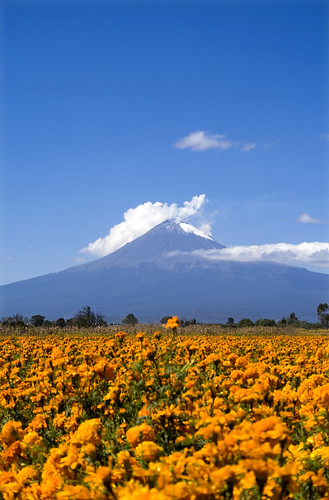
With the bumper crop of wacko right-wing candidates poised to win big, the outlook is gloomy. Here in Mexico though, I think Nov 2nd will be a happier day. Shelves are lined with statuettes of Michael Jackson as a skeleton, florists are hawking bouquets of cempasúchil, and bakeries are selling rich buttery loaves of pan de muerto.


Saturday, October 16, 2010

Sunday, October 3, 2010

Movie review: El Infierno

Yesterday I watched a short BBC news clip about narcocine, which are generally straight to DVD flicks financed by drug lords to celebrate their exploits. Also mentioned was this controversial film El Infierno, (hell) currently playing in Mexican theaters. Jenny and I went out to see it last night.

If anything El Infierno mocks the lifestyle of the narcos, but that doesn't mean the government likes it. Mexican officials, including the president, have lined up to criticize this film, which is I think the best press coverage a movie like this could hope for. Like the U.S., Mexico is a country that engages in a fair amount of flag-draped patriotic gobbledygook. Those bicentennial México 2010 signs (see image) have become more conspicuous than taco stands. The graffiti scrawled under this one reads: nada que celebrar (nothing to celebrate). In a feat of admirable chutzpah, the director managed to get a fair amount of money out of the Mexican government to make this film, then released it right at the bicentennial. The film is over the top, violent, foul-mouthed, and really funny.

It follows the story of an espanglish speaking immigrant who is deported back to Mexico after 20 years to find that his brother became a chingón in the local mafia before being gunned down. Wanting to find out what happened to his brother and with few employment options, the humble pinche pocho slowly gets entangled in the world of narcotraficantes.

Exaggerated, casual, and even humorous violence has become fairly common in movies, but it was far stranger to see it in this one. In the U.S. we may indulge in such fantasies, but when was the last time you saw an actual news story (domestic) about someone beheaded with a chainsaw or dissolved in a barrel of acid? In Mexico this stuff really happens, which made this kind of scene very disturbing (especially with the whole audience, including myself, rolling with laughter).

We only got about half as many jokes as the rest of the audience, but it was still hilarious. It takes the piss out of every authority figure in Mexico, from politicians groveling at the feet of drug lords, to clergy sprinkling holy water on handguns for US $100 bills, to policemen who can be bribed with a handful of drugs, to federales who hand their informants back over to the mafia. One of the things I found funniest was all of the gaudy, tacky, chafa shit they spend their money on. The narcos strut around like peacocks with stuffed tigers and gold-tipped cowboy boots, while everything in the background is dust, concrete, and broken down cars. In one scene the main character, now a successful narco, decides to help out his godfather who runs a failing tire shop. A new, brightly painted store with flashing lights is shown where the ramshackle building once stood.

"Thanks," his dazed godfather replies with a straight face, "now all I need are customers."